Bandung Spirit and Hyper-Imperialism
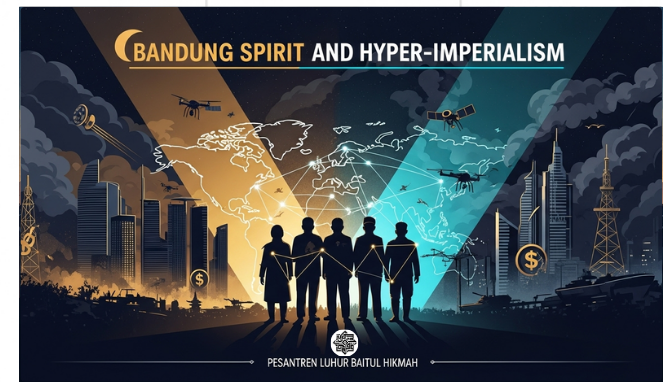
Faizis Sururi, All brothers
On celebrating seventy years of the Asia-Africa Conference which is widely known as the Bandung Spirit, we have known together that since the coup by Soeharto, Indonesia was not in this line of the spirit: against imperialism. The New Order era was a rise of capital in Indonesia, a marker of the beginning of the industrial state, and the victory of U.S. imperialism over Southeast Asian resistance.
Also Read: The Spiritual Compass We’ve Lost
Following the Bandung Spirit, how does imperialism work? How does it operate within an economic war? How far does the economic war rebuild imperialism or the current global order? Vijay Prashad, Director of the Tricontinental Institute, writes in his analyses that hyper-imperialism, as he calls it, operates through the value chain.
This term value chain, in Marxist tradition, is similar to (or politically euphemised from) terms such as steal, rob, neo-colonialism, etc. In this fact, we are aware of who colonises and who is colonised. Looking from the global order, who colonises is represented by G-7 + NATO (North Atlantic Treaty Organization) and who is colonised is represented by what we usually call the Third World.
Since the first conference was held, we have not seen any fundamental change in the global order. The abbreviation “NATO” describes clearly how we celebrate the Bandung Spirit now: No Action, Talk Only. Imperialism remains the main actor in this global order, and each conference becomes only talk.
On the other side, since the Third Great Depression of 2007/2008, the Global South, represented by China, began shifting the economic geography. Following this shift, under the leadership of Prabowo, Indonesia entered BRICS. Consequently, Indonesia joined the project of the New Silk Road or the Belt and Road Initiative. Triggered by China’s manoeuvre, the economic war has begun.
See Also: The Concept of Prophetic Philosophy
The question is: How does the Global North react to the economic war? NATO. Yes, it is truly an unequal war. Instead of improving the economy, the Global North responds to this war with militarism. Written in the Tricontinental Institute: most government spending of the U.S. Gross Domestic Product (GDP) is arms expenditure.
For so long, Vijay Prashad writes:
However, there are a set of factors that limit the emergence of a new Bandung era in the Global South:
There remains both a fear of and desire for Western leadership despite its many failures, its decadence, and its dangerousness. It is logical that the states of the Global South fear the possibility of war by all means (from unilateral coercive measures to aerial bombardment) because this is not a theoretical assumption, but an actual fact.
Yet, at the same time, there is a captivating sense that Western leadership is necessary given the remains of the Western-dominated international order.There is a lack of clarity in the Global South about the advances made in Asia, especially by China. Other countries do not see these gains, particularly when it comes to the qualitatively new productive forces, as easily replicable, which leads to a mutual underestimation of the potential strength of a collective Global South. Furthermore, against the available evidence, a growing belief pushed by the Global North suggests that the advances of the locomotives of the Global South will be dangerous for poorer countries. It is suggested that the advances of Asian countries, in particular, are more of a threat than the long record of danger from the Global North over hundreds of years.
There is a surrender to the reality of the West’s control over the digital, media, and financial landscapes, which is made to seem unsurpassable.
A significant portion of the ruling economic elite in the Global South remains deeply intertwined with global financial capital. This is particularly evident in their dependency on the U.S. dollar as a safe haven for investment and their participation in extracting wealth from their own countries to invest in the Global North’s real estate and financial markets. These class interests are readily supported by intellectuals and policymakers who cannot see beyond the theories of neoclassical economics and the Washington Consensus.
That is why we at Tricontinental have argued for a new development theory for the Global South.There are old habits in many of our social movements that the left must permanently oppose the realities of class politics and that we cannot win power in these conditions. Any compromise with reality to take power and build our agenda further is seen as a dissolution of our final aims. The failure to win is a captivating sensibility that was unknown in the national liberation era, when winning state power was the immediate and intractable goal. There is even an orientation suggesting that left movements should fight the right, build a dynamic against neoliberalism, and then, rather than demand and seize state power, deliver power to the centre-left. The worst orientation is to not contest state power at all.